Respiratory Protection for Health Care Workers: Meet the Experts
Presenter(s): Jane L. Whitelaw, Kate Cole, Dr Suzi Nou, Mark Reggers, Alex Birrell & Graeme Powe
The last 6 months has seen a rapid increase in awareness of the role of respiratory protection for health care workers. With over 3500 health workers infected with SARS-CoV-2 in Victoria, and the majority acquiring it from the workplace, the question about the adequacy of respiratory protection has justifiably arisen.
There has been ongoing concern regarding supply and quality of disposable respirators. Many industries in Australia and health settings overseas have implemented the use of air purifying respirators (APRs) and powered air purifying respirators (PAPRs). Widespread implementation of these in Australian healthcare settings is yet to be seen.
Many reasons have been provided for this lack of implementation, such as respirators not being fit for use in healthcare settings and particularly around cleaning and safe handling of respirators.
This interactive webinar is an opportunity to meet the experts behind the three most common reusable products and ask your questions.
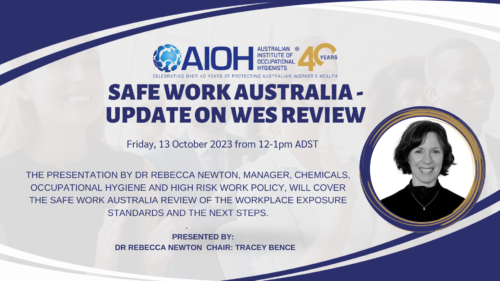
The presentation by Dr Rebecca Newton, Manager, Chemicals, Occupational Hygiene and High Risk Work Policy, will cover the Safe Work Australia review of the Workplace Exposure Standards and the next steps.
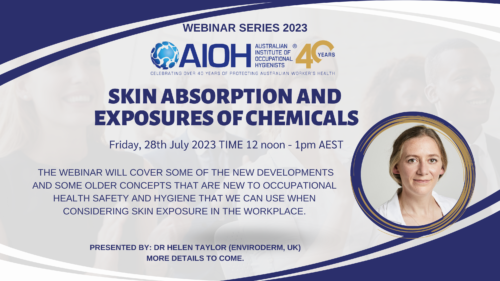
The webinar will cover some of the new developments and some older concepts that are new to occupational health safety and hygiene that we can use when considering skin exposure in the workplace.
The Australian Institute of Occupational Hygienists (AIOH) launched Breathe Freely Australia in 2018, which provides readily available information for workers and supervisors about the hazards of toxic dust and prevention of lung diseases in various industries. In 2020, the AIOH started the RESP-FIT program, which is relevant to those who rely on respirators as protection against harmful dust. As many lung diseases are serious and irreversible, the focus must be on prevention of harm. Workers in the manufactured stone sector rely on many control measures to protect them from lung diseases such as silicosis, with one of them being respiratory protection.
This webinar will discuss the unusual characteristics of these chemicals, the most important exposure pathways relevant in workplaces and some of the controversy surrounding reference doses for protection of human health. Presented by Therese Manning - Principal, EnRiskS and AIOH President Kate Cole
COMED (Control Measures Efficiency Database) is a web-based tool which contains reliable, objective data on efficiency of exposure control measures. It enables users to compare efficiencies of different control options and identify key performance characteristics.
The presentation discusses the wide use of solvents in the workplace and often used in large quantities; used for dry-cleaning, in paints and varnishes, pharmaceuticals, degreasers, adhesives, glues, printing inks, pesticides, cosmetics, and household cleaning products.
This presentation will discuss the exposure, absorption, metabolism, and toxic effects of solvents.
This talk will be wide ranging from the immediate resource impacts of nuclear submarines to the longer term philosophical impacts of nuclear accidents such as Chernobyl and Fukushima. The talk will provide an international and national perspective on workplace and environmental radiation management and the potential opportunities for AIOH members in this space.
The pathway to becoming a senior professional can be different for every occupational hygienist. While there is no “right” or “wrong” way to create a successful career in occupational hygiene, the attributes of education, technical knowledge, service and leadership all form a crucial part of leaving a legacy.
April 2022, The presentation examines the dangers of welding fume and the different product control methods - the advantages and disadvantages of each.